


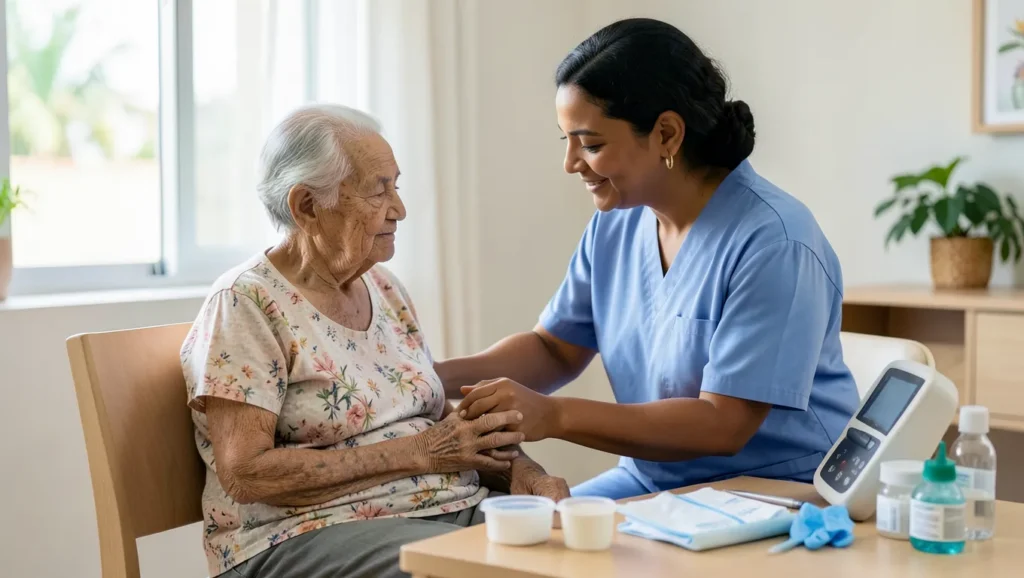
GERIATRIC FIRST AID AWARENESS
Learn to recognise, respond to and steady an older person through a medical emergency until help arrives.
Start Course Now →Older people face first aid situations that behave differently from those in younger adults, from falls and fractures to time-critical medical emergencies. This foundation course helps you recognise the warning signs early, act calmly and safely, and know when and how to get further help. It is for carers, family members, support workers and anyone who spends time around older adults.
Walk out able to actually help.
Spot the early signs of time-critical emergencies such as stroke, cardiac events and choking in older people.
Approach safely, carry out an initial assessment and activate emergency help in the right order.
Give appropriate first aid for falls, fractures, head injuries and bleeding while waiting for support.
Support and protect the older person, and reduce the risk of future emergencies through prevention.
Built around the moment it matters.
Course Description
An overview of what the course covers and how it is structured.
Standards and Professional Framework Alignment
How the course maps to recognised professional standards and frameworks.
Course Objective
The core aim of the course and what you are working towards.
Course Learning Outcomes
The specific capabilities you will be able to demonstrate on completion.
Module 1 — Foundations of Geriatric First Aid
The principles behind first aid for older people, with a scenario and key takeaway to ground the basics.
Module 2 — Safe Approach, Initial Assessment and Emergency Activation
Approaching safely, assessing the person and activating emergency help, reinforced with a scenario and knowledge check.
Module 3 — Falls, Fractures, Head Injuries and Bleeding
Responding to falls and their common injuries, from fractures and head trauma to bleeding.
Module 4 — Recognising Time-Critical Medical Emergencies
Identifying emergencies where minutes matter and acting without delay.
Module 5 — Airway, Choking, Breathing Emergencies and CPR/AED Awareness
Managing airway and breathing problems, choking, and building awareness of CPR and AED use.
Module 6 — Medication, Environmental and Other Common Emergencies
Handling medication-related, environmental and other everyday emergencies affecting older people.
Module 7 — Safeguarding, Prevention and Supporting the Older Person
Protecting and supporting the older person and preventing future incidents.
Course Summary
A consolidation of the key points drawn together across the modules.
Final Application Scenario
A realistic scenario with decision points that lets you apply what you have learned.
Course Completion Message
Your closing summary and confirmation as you complete the course.
Where this learning adds value.
Build practical capability you can apply immediately, and evidence of structured professional development.
Every programme sits on a pathway, so you can progress from foundation into the specialist streams your role or sector demands.
Contractors and suppliers are routinely asked to evidence trained personnel — structured training supports that case where the course is relevant.
Digital credentials can be independently verified online by employers and credential reviewers. Recognition requirements may vary by employer, jurisdiction, profession and certification type.
A certificate that carries weight.
Apexis Certificate of Completion
Issued by Apexis Risk Innovation Group on successful completion of the programme requirements. Where digital verification is enabled, employers can verify the credential record online.


Apexis Risk Innovation Group is an authorised TEEX Cooperative Learning Center. Selected Texas A&M Engineering Extension Service (TEEX) programmes delivered through Apexis are clearly identified by course name and code.
Who you learn it from matters.
Selected TEEX programmes are available through Apexis Risk Innovation Group, an authorised Texas A&M Engineering Extension Service (TEEX) Cooperative Learning Center, and are clearly identified by course name and code.
Programmes are designed by people who have done the job, around real workplace needs rather than textbook abstractions.
Content is contextualised to the operating environments our clients actually work in — energy, industrial, public safety and emergency response.
Every programme identifies who issues the credential, what it represents and how it can be verified.
Ready when you are.
- Self-paced online modules
- Real-world scenarios and decision points
- Knowledge checks to test your understanding
- A final application scenario
- Certificate of completion